How Much Exercise Does a Coonhound Need? Plus Brain Games
General training information. Every dog is an individual; for health or behavior concerns, see your veterinarian.
If you are asking how much exercise a Coonhound needs, the short answer is more than a lap around the block, and not only with legs. These are hounds bred to follow a trail and stay on it. A tired body helps, but a busy nose and brain are what make an evening at home feel calmer.
One note before we start. The American Kennel Club recognizes six separate coonhound breeds: American English, Black and Tan, Bluetick, Plott, Redbone and Treeing Walker. The figures below describe the Black and Tan Coonhound only. If you share your home with one of the other five, check with that breed's club for its own guidance. Individual dogs vary, so treat every number here as a starting point.
What the Black and Tan's Exercise Needs Look Like
Vetstreet suggests at least a half hour walk once or twice daily, on leash, along with a securely fenced yard. Hill's Pet Australia says the breed needs more than 40 minutes of exercise a day. Those two sources differ a little, so think of the range as a floor and not a ceiling.
Hill's lists the Black and Tan's energy as "laid back" while also stating that vigorous daily exercise is a must. That matches the pattern many hound owners describe: a dog that naps happily indoors, but only after the day's work has been done.
Two details in the breed notes shape how you exercise a Coonhound:
- Orvis says the breed chases scents, so it should be kept on leash.
- Vetstreet pairs the exercise advice with a securely fenced yard, which tells you free running is only safe inside real fencing.
The original job explains both points. Hill's describes the breed as a raccoon hunter that works as a trail and tree hound, and was also used on opossum and larger game. A dog built to follow a track for miles is not built to come back the moment you call.
Exercise by Life Stage
Puppies
The breed sources we rely on do not give a puppy exercise limit, so there is no number to quote here. Large, long-bodied hounds are still growing for a while, and hip problems are listed among the breed's health concerns. Ask your veterinarian how much running, jumping and stair climbing is right for your puppy at each checkup, and ask the breeder what they recommend too.
What you can do safely is keep puppy outings short, on soft ground, and focused on sniffing and gentle play. Save the long hikes for later. Early training is also worth starting now. Embrace Pet Insurance advises beginning early with positive reinforcement.
Adults
Adults are the group the published numbers describe. Plan on a half hour walk once or twice a day as the minimum, and aim above 40 minutes of total activity if your dog seems to need it. Mix the type of work. A fast walk, a slow sniffing walk and a training session each use the dog differently.
Seniors
Orvis gives the breed's life expectancy as 10 to 12 years. No source we use sets a senior exercise amount, so let your veterinarian guide you. Embrace Pet Insurance lists hip dysplasia among the breed's common health issues, and an older dog with sore joints may need shorter, gentler outings. Brain games become even more useful here, because they tire a dog without hard impact.
Materials You Will Need
You do not need special equipment. Gather these:
- A standard flat collar or a well-fitted harness, and a leash. A long line of 15 to 30 feet is handy for sniff walks in open areas.
- Small, soft food rewards your dog loves, cut into pea-sized pieces.
- A puzzle feeder, a snuffle mat, or a muffin tin and a few tennis balls to make your own.
- A few cardboard boxes or old towels for hiding treats.
- A securely fenced yard or a safe, enclosed space, if you want off-leash time at all.
- Water and a bag for cleanup.
Embrace Pet Insurance notes that food rewards work well for this breed, so the treat bag will earn its place.
Step-by-Step: Building a Daily Coonhound Exercise Plan
Step 1: Start With a Vet Check
Before you set a routine, ask your veterinarian whether your dog's age, weight and joints are ready for it. This matters most for puppies, seniors and any dog with a known hip or heart concern. Your vet is also the right person for questions about weight, limping or sudden changes in energy.
Step 2: Set a Baseline Walk Schedule
Start with one or two leashed walks a day of at least 30 minutes each, in line with the Vetstreet guidance. Walk at the same times each day, since hounds tend to settle better with a predictable rhythm. If your dog is not used to that much activity, build up over a couple of weeks rather than starting at full length.
Step 3: Turn One Walk Into a Sniff Walk
This is the single best coonhound mental stimulation tool you have. On a sniff walk, the dog decides where to go and how long to stay on each smell, within the limits of a safe leash.
- Choose a quiet route with grass, hedges and leaf litter, away from heavy traffic.
- Clip the leash to a harness and let the line out so your dog can range a few feet.
- Pick a pace that follows the nose. Stop when your dog stops.
- Give a cue such as "go sniff" as you release them to investigate a spot, so it becomes a signal you can use later.
- After a few minutes, ask for a simple behavior such as a sit, reward it, and release to sniff again.
Keep the leash on. Orvis warns that the breed chases scents, and a hound on a hot trail may not hear you.
Step 4: Add a Puzzle Feeder or Scatter Meal
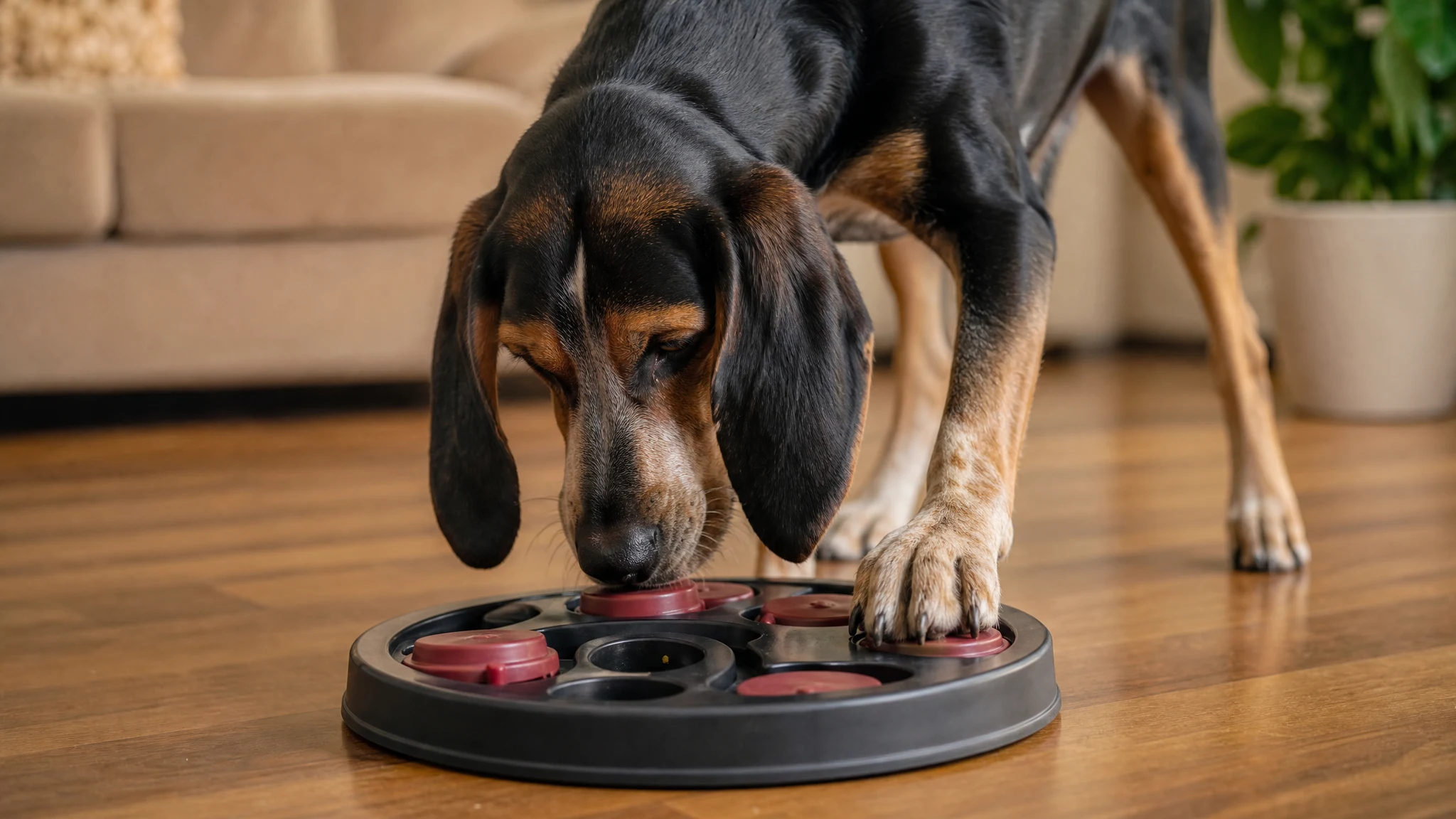
Swap one bowl meal a day for a food puzzle. Scatter the kibble across the lawn or a snuffle mat, or put a piece of food in each cup of a muffin tin and cover each with a tennis ball. Your dog has to nose and push the balls aside to eat.
Start easy. If the puzzle is too hard at first, a hound will lose interest. Make it a little harder each week as your dog gets the idea. Pick up the puzzle when the meal is done.
Step 5: Play a Trail Game That Matches the Original Job
The Black and Tan was developed as a trail and tree hound, so games that let your dog follow a track suit the breed. Embrace Pet Insurance also suggests tracking and search and rescue as outlets. Here is a simple way to play at home:
- Have a helper hold your dog, or place your dog in another room.
- Drag a treat or a scented cloth along the ground in a short, straight line, about 10 to 15 steps. Leave a jackpot of treats at the end.
- Bring your dog to the start of the line and say "find it."
- Let your dog work the track at their own speed. Do not rush or pull.
- When they arrive, praise them and let them eat the reward.
After several successes, add a turn, then a longer trail, then a delay before you start. Move to grass and then to unfamiliar spots as your dog improves.
Step 6: Play Hide and Find
Show your dog a treat or a favorite toy, then hide it in an easy place, such as behind a chair leg or under a towel. Say "find it" and let your dog search. Praise the find and repeat.
Make hiding spots harder over time: another room, behind a door, inside a cardboard box with the flaps open. This is a handy rainy-day game and gives you a good reason to practice a calm wait before the search starts.
Step 7: Practice Short Training Sessions
Orvis describes the breed as easily distracted and not always willing to do as asked, and Hill's says training can be harder than with some other breeds and needs patience and consistency. So keep sessions short, five minutes or so, and end on a success. Work on a sit, a down, a hand target and a recall on a long line. The skills in our complete guide to training a Coonhound pair well with these games.
Use only rewards, praise and toys. Gentle, reward-based training is the approach backed by the American Veterinary Society of Animal Behavior, and it keeps a sensitive, scent-driven dog willing to work with you.
Step 8: Finish With Calm Time
End the day's activity with a chew, a lick mat or a rest on a mat. A dog that learns to switch off after work is easier to live with. Praise quiet settling and give a reward for it, so it becomes a habit.
A Sample Week
| Day | Physical work | Brain work |
|---|---|---|
| Monday | 30 minute leashed walk, morning and evening | Puzzle feeder at breakfast |
| Tuesday | Brisk walk plus sniff walk | Hide and find indoors |
| Wednesday | Two leashed walks | Scatter meal and a short training session |
| Thursday | Long sniff walk on a long line | Trail game in the yard |
| Friday | Two leashed walks | Muffin tin puzzle |
| Saturday | Longer outing in a new place, on leash | Trail game with a new surface |
| Sunday | Easy walk and rest | Chew or lick mat |
Adjust it to your own dog. If yours is still a puppy or is getting older, shorten the physical work and lean on the brain games, with your veterinarian's advice.
Tips for Success
- Let the nose lead. Five minutes of real sniffing can be more satisfying to a hound than a fast trot with no stops.
- Use a fenced yard, not just a yard. Vetstreet pairs the exercise advice with secure fencing for a reason.
- Rotate the games. A new puzzle or a new place keeps the work interesting.
- Count treats. Take the food you use in games out of the daily meal so the extra rewards do not pile on extra weight.
- Check the ears after outdoor time. Embrace Pet Insurance lists ear infections from floppy ears among the breed's common issues, so ask your veterinarian what to watch for.
Common Mistakes to Avoid
- Trusting recall off leash. A scent can override even a well-trained dog. Use a leash or a long line outside a fence.
- Skipping the mental work. Extra walking is not a full replacement for puzzles and scent games.
- Overdoing it with a puppy. No source here sets a puppy limit, so ask your veterinarian before long runs or jumping.
- Expecting instant obedience. Hill's says patience and consistency are needed. Keep sessions short and upbeat.
- Using harsh corrections. Never use shock, prong or choke collars, or physical punishment. They can damage trust and are not part of reward-based training.
- Ignoring the howl. Orvis lists howling among the breed's challenges. A bored hound often finds a voice. More outlets for the nose may help, though there are no promises. Talk with a qualified trainer if it becomes a problem.
What Results to Expect
With steady daily walks and scent games, many owners find their dog settles more easily at home and is less likely to look for its own entertainment. Over a few weeks, a dog may become more focused during training and may be more willing to rest after activity. Results vary from dog to dog, and age, health and temperament all play a part.
If your dog seems unusually tired, sore, short of breath or reluctant to move, stop and call your veterinarian. Do not try to work through it.