How to Train a Coonhound: The Complete Guide
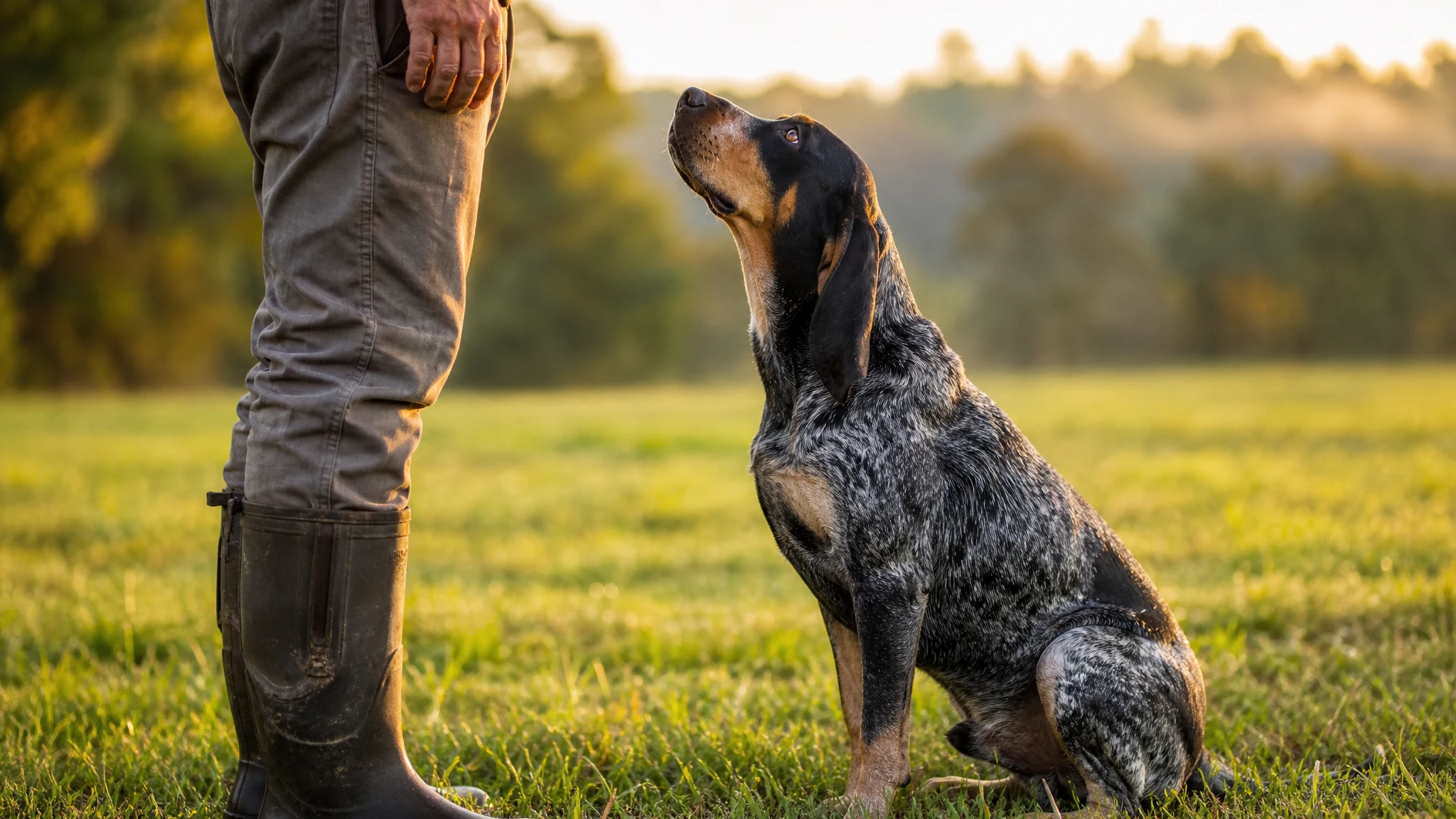
General training information. Every dog is an individual; for health or behavior concerns, see your veterinarian.
Coonhound training starts with understanding the dog. This is a hound that was built to follow a trail, stay on it, and think for himself while he does. That is wonderful in the field. In a living room, it can feel like you are negotiating with a very handsome, very stubborn nose.
This guide covers how to train a coonhound from puppyhood to adulthood. It leans on what published breed sources say, and it gives you practical coonhound training tips you can start using this week. It focuses on the Black and Tan Coonhound, the first AKC coonhound. The AKC recognises six separate coonhound breeds, so if you share your home with a Bluetick, Redbone, Plott, Treeing Walker or American English, check with that breed's club for details specific to your dog.
Key Takeaways
- The Black and Tan Coonhound was developed for raccoon hunting as a trail and tree hound, so scent and independence shape everything about training.
- Hill's Pet Australia says training can be more challenging than with other breeds and needs patient, consistent work.
- Begin early with positive reinforcement. Embrace Pet Insurance notes that food rewards work well.
- Keep your dog on a leash outdoors and use a securely fenced yard. Orvis says these hounds chase scents.
- Daily exercise is not optional. Vetstreet suggests at least a half hour walk once or twice daily.
- Plan for distraction, selective listening and howling. Individual dogs vary, so adjust to the dog in front of you.
- Questions about health, pain or sudden changes in behavior belong with your veterinarian.
Table of Contents
- What the Coonhound Was Bred For and Why It Matters
- Training Stages: Puppy to Adult
- Motivation That Works for a Coonhound
- Core Skills to Teach
- Exercise and Mental Work
- Challenges to Plan For
- Health and Training: What to Raise With Your Vet
- Putting It Together: A Simple Weekly Plan
What the Coonhound Was Bred For and Why It Matters
Every good training plan begins with the job the dog was made for. Vetstreet says the Black and Tan Coonhound was developed in the southern United States in the late 18th century from Foxhounds and probably the Bloodhound. Hill's Pet Australia describes the original purpose as raccoon hunting, working as a trail and tree hound. The breed was also used on opossum and larger game.
Think about what that job demands. A trail hound has to pick up a scent, follow it a long way, and keep going when conditions are rough. A tree hound has to hold the quarry and tell the hunter where it is. Both jobs reward a dog who works independently, with his nose in charge.
How the job shapes the dog in your home
Orvis lists the breed as easily distracted and not always willing to do as asked. It also notes that these dogs chase scents, which is why they should be kept on a leash. Orvis also lists howling among the known challenges.
None of this means a coonhound is a bad student. It means his priorities are different from a dog bred to watch your face. When you understand that, the stubborn moments stop feeling personal.
Temperament in plain words
Hill's Pet Australia describes the temperament as responsive, intelligent, loyal and passionate about his work. It says the breed is generally outgoing and friendly, though some dogs are reserved with strangers. Orvis calls the breed devoted to family and kind and gentle with people of all ages. Vetstreet says these dogs should never be aggressive toward other dogs.
Those are breed descriptions from secondary sources, not guarantees about your dog. Some coonhounds will be bold, some careful, some goofy. Watch your own dog and train the one you have.
Size matters for training too
Vetstreet gives the height as 23 to 27 inches at the shoulder. Weight reports differ by source. Vetstreet says 65 to 100 pounds, while Hill's Pet Australia gives 60 to 75 pounds for males and 55 to 70 pounds for females. Either way, this is a large, strong hound. A puppy who pulls on the leash or jumps up today will be a much bigger problem at full size, so good habits are worth building early.
Training Stages: Puppy to Adult
Embrace Pet Insurance recommends beginning early with positive reinforcement. Beyond that, no source in our research gives a firm timeline for coonhound puppy development, so treat the stages below as a practical framework rather than a calendar. Ask your veterinarian about vaccination timing before taking a young puppy to public places or dog classes.
Stage 1: The new puppy at home
The first weeks are about routine and trust. Focus on a handful of simple goals:
- A predictable schedule for meals, potty trips, naps and play.
- A crate or pen that feels like a safe den, introduced with treats and calm praise.
- Gentle handling of paws, ears and mouth. Floppy-eared dogs need their ears checked, and a dog who is used to being touched makes vet visits easier.
- Name recognition. Say the name, reward when he looks at you.
Keep sessions short. A few minutes of focused practice, several times a day, beats one long session that ends in frustration.
Stage 2: Foundation skills
Once the puppy is settled, start teaching the basics: sit, down, come, wait and leave it. Use treats, praise and play. Practice in low-distraction places first, like a quiet room, then move to the backyard, then to the street.
This is also the time to teach loose-leash walking. A hound who learns that pulling never works, and that staying near you pays off, will be far easier to walk at 70 pounds or more.
Stage 3: Adding distractions
For a coonhound, distractions are mostly smells. This stage is where many owners get discouraged, because a dog who sat perfectly in the kitchen ignores you in the park. That is normal for a scent hound.
Make the step up gradual. Practice a known skill at a slightly harder location, reward generously, and go back an easy step if he struggles. Raise the difficulty one small notch at a time.
Stage 4: The adolescent
Many dogs go through a phase where they seem to forget things they knew well. Do not take it as defiance. Go back to basics, keep rewards strong, and stay patient. Hill's Pet Australia stresses patient, consistent training for this breed, and adolescence is when that advice earns its keep.
Keep the leash on outdoors during this stage. A dog with a developing nose and growing confidence is the one most likely to follow a trail straight out of sight.
Stage 5: The adult dog
Adult training is about maintenance and enrichment. Keep practicing the skills you taught, add new ones, and give the dog jobs. Orvis lists a life expectancy of 10 to 12 years, which is a long time to share a home. A coonhound who keeps learning stays engaged, and an engaged hound is less likely to invent his own entertainment.
Adult dogs can learn too. If you adopted an older coonhound, the same methods apply. Start where the dog is, not where you wish he were.
Motivation That Works for a Coonhound
Humane, reward-based training is the approach recommended by the American Veterinary Society of Animal Behavior (AVSAB), and it suits this breed well. Embrace Pet Insurance says food rewards work well for the Black and Tan Coonhound. That fits the picture of a nose-driven dog.
Use food, and use it well
Small, soft, smelly treats work best for quick repetition. Save the best rewards for the hardest tasks, like coming when called outdoors. Use part of your dog's regular meal as training rewards on busy days so the treats do not add up. Ask your veterinarian how much to feed if your dog is gaining weight.
Let the nose be part of the reward
Sniffing is a reward this breed already values. Use it. After your dog does a good loose-leash walk, say a release word and let him sniff a patch of grass for a minute. Over time he learns that doing what you ask earns him access to what he wants.
Praise and play
Many hounds enjoy a happy voice, a scratch and a bit of play, though some are less impressed than they are by food. Test different rewards and see what your dog works hardest for. Individual dogs vary.
Timing and consistency
Mark the exact moment of success with a word like "yes" or a clicker, then deliver the treat. Everyone in the household should use the same cues and the same rules. A dog who is allowed on the couch by one person and scolded by another will not understand the game.
What to avoid
Do not use shock, prong or choke collars. Do not use alpha rolls, scruffing or any dominance method. They add fear and confusion and can damage your relationship with the dog. A patient hound with a mind of his own does not need force. He needs a clear plan and better rewards than the squirrel trail on the ground.
Core Skills to Teach
Come when called
This is the skill every coonhound owner wants and the one that is hardest to trust. Orvis says these dogs chase scents, so the safest rule is simple: keep your dog on a leash outside of a securely fenced area.
To build a reliable recall:
- Pick a cheerful cue word and use it only for coming to you.
- Practice indoors first. Say the cue, and reward big when he arrives.
- Move to the fenced yard, then to a long line outdoors.
- Never call your dog to you for something he dislikes, such as a bath or nail trim. Go and get him instead.
- Always pay well. Think of it as a jackpot, not a single treat.
Keep practicing for the dog's whole life. Even a well-trained recall can fail when a strong scent is in the air, which is why the leash stays on in open areas.
Loose-leash walking
A hound with his nose down will pull toward interesting smells. Teach him that a slack leash lets him move forward and a tight leash stops the walk. Stop when he pulls, wait for the leash to loosen, then proceed. Reward when he walks beside you. A well-fitted harness or flat collar is a humane choice, and a front-clip harness can help some dogs.
Sit, down and stay
These give you control in everyday life, like at the door or at the vet. Keep the stays short at first and add duration slowly. Reward calm behavior frequently.
Leave it
For a scent hound, this is a very useful cue. Start with a low-value item under your hand, reward when he backs off, then work up to harder items. It helps with trash, dropped food and things he should not eat. If your dog eats something dangerous, call your veterinarian right away.
Settle on a mat
A dog who knows how to relax on cue is a pleasure to have around. Reward him for lying on a mat, then gradually extend the time. This gives him an off switch after a busy walk, and it helps with visitors and mealtimes.
Quiet and howling
Orvis lists howling as a known challenge. A howl is part of the breed's history, so you may never remove it completely. You can manage it. Reward quiet moments, make sure he gets enough exercise and attention, and avoid yelling, which many dogs take as joining in. If the howling seems tied to distress when left alone, talk to your veterinarian or a qualified reward-based trainer.
Socialization
Hill's Pet Australia says some Black and Tan Coonhounds are reserved with strangers. Gentle, positive exposure to new people, places, sounds and surfaces helps a dog grow into a confident adult. Go slowly, keep experiences pleasant, and never force a nervous dog to face something scary. Let him watch from a distance and reward calm behavior.
Exercise and Mental Work
A bored coonhound will find his own work, and you will probably not like his choices. Meeting his physical and mental needs is part of training, not separate from it.
How much exercise
Vetstreet suggests at least a half hour walk once or twice daily, on leash, along with a securely fenced yard. Hill's Pet Australia says more than 40 minutes a day. Hill's also lists the energy attribute as "laid back" while stating that vigorous daily exercise is a must. So this may be a dog who naps happily at home, but he still needs real exercise every day.
Use these numbers as a starting point, and ask your veterinarian what is right for your dog's age and health. Growing puppies should not be over-exercised, so check with your vet before building up long or intense outings.
Fence and leash rules
A secure yard matters. A scent hound who catches a trail may go over or under a weak fence. Check the fence regularly for gaps and for places where he could dig. Stay with your dog when he is outside, especially early on.
Let him use his nose
Walks do not have to be a march. Slow, sniff-heavy walks give a trail hound the mental work he was bred for. Try a "sniff walk" where you follow his lead, on a long leash in a safe area, a couple of times a week.
Scent games at home
Easy ways to give the nose a job:
- Treat hunt: Scatter treats in the grass or hide them around a room and let him find them.
- Find it: Hide a favorite toy and tell him to search.
- Snuffle mat or food puzzle: Feed part of a meal this way.
- Trail laying: Drag a treat along the ground, hide it at the end, and let him follow.
These games also build focus on you, because you are the source of the fun.
Sports and jobs
Embrace Pet Insurance lists raccoon hunting as the breed's traditional work and suggests tracking and search and rescue as other outlets. If you are interested in organized activities, check with local clubs or the breed's parent club about what is available and what suits your dog. We cannot point you to specific programs from here.
Challenges to Plan For
Distraction
Orvis lists the breed as easily distracted. Plan for it. Train in short sessions, start in quiet places, use rewards the dog loves, and expect your dog to do better at home than outdoors. Do not test a skill in a place where he is not ready.
Selective listening
The same source says these dogs are not always willing to do as asked. Hill's Pet Australia adds that training can be more challenging than with other breeds. The fix is rarely more pressure. Make your rewards more interesting, shorten your sessions, and be consistent about what you ask.
If your dog ignores a cue, ask yourself a few questions. Is it too hard here? Is the treat good enough? Did I repeat the cue five times? Adjust the plan, not the dog's character.
Scent chasing
Because of the breed's trailing instinct, the leash is your safety net. Do not trust a coonhound off leash in an unfenced area, however good his recall is at home. Use a long line for practice and a secure fence for free time.
Howling
Expect some noise. Think about neighbors, and work on quiet cues and exercise early. If you live in an apartment or close to others, talk through your plans with your landlord or housing rules before bringing a dog home. Check local rules with your city or housing provider, as we cannot cite specific noise rules here.
Pulling and size
A large hound on a strong scent can pull hard. Start loose-leash training in puppyhood. If you are not sure you could hold your dog in a surprise moment, use a secure harness and a sturdy leash, and keep your grip firm.
Patience, yours
The hardest part of coonhound training is often the trainer's patience. Progress may come in small steps with a few steps back. Celebrate the wins, and keep sessions short and positive so both of you stay motivated.
When to get help
If you are struggling with aggression, fear, severe separation distress or anything that worries you, talk to your veterinarian first to rule out medical causes. They can also refer you to a qualified trainer who uses reward-based methods in line with AVSAB guidance. Ask any trainer how they work before you book, and walk away from anyone who recommends shock, prong or choke collars or dominance methods.
Health and Training: What to Raise With Your Vet
Health and training are connected. A dog in pain may not want to sit, jump or walk, and what looks like stubbornness may be discomfort. This section is not medical advice, and only a veterinarian can diagnose or treat a dog.
Embrace Pet Insurance lists these as common health issues for the Black and Tan Coonhound:
- Hip dysplasia
- Autoimmune thyroiditis
- Ectropion
- Hemophilia B in some dogs
- Ear infections from floppy ears
- Coonhound paralysis (also noted by Vetstreet)
Vetstreet lists these health screens for the breed: a hip evaluation (OFA or PennHIP), eye certification through the Canine Eye Registry Foundation, and an OFA cardiac evaluation. If you are buying a puppy, ask the breeder which screens the parents have had and ask to see the results. If you adopt, ask your vet what to watch for.
Practical points for training:
- If your dog suddenly resists a skill he used to do, such as sitting or jumping into the car, get him checked before assuming it is behavior.
- Tell your vet about any weakness, wobbling or trouble walking right away.
- Check and clean ears only as your vet advises. Do not guess at ear products or medicine.
- Ask your vet before starting strenuous exercise with a young or older dog.
Putting It Together: A Simple Weekly Plan
Here is a plan you can adapt. It is not a prescription, just a way to keep daily habits steady.
- Every day: One or two walks on leash (at least a half hour each, per Vetstreet), two or three short training sessions of five minutes or so, and one scent game.
- Several times a week: A slow sniff walk, a recall practice on a long line in a safe area, and a calm settle session on the mat.
- Once a week: Try one new skill, one new place or one new puzzle. Check the fence and your dog's gear.
- Every month: Review your progress. Which cues are solid? Which fall apart outdoors? Adjust your rewards and your practice locations.
Mistakes to avoid
- Letting a young hound off leash in an unfenced area.
- Repeating a cue over and over instead of resetting the exercise.
- Skipping exercise and expecting calm behavior at home.
- Using harsh corrections. They do not fit AVSAB guidance and they can break trust.
- Giving up too soon. Hounds often need more repetitions and more patience.
Final thoughts
A coonhound is not the easiest dog to train, and the breed sources say as much. But he is also devoted, intelligent and full of character. If you work with his nose instead of against it, keep rewards high and sessions short, and stay consistent, you can build a lasting partnership. Take the wins as they come, keep the leash on outdoors, and enjoy the dog you have.