Coonhound Puppy Training Timeline: 8 Weeks to 2 Years
General training information. Every dog is an individual; for health or behavior concerns, see your veterinarian.
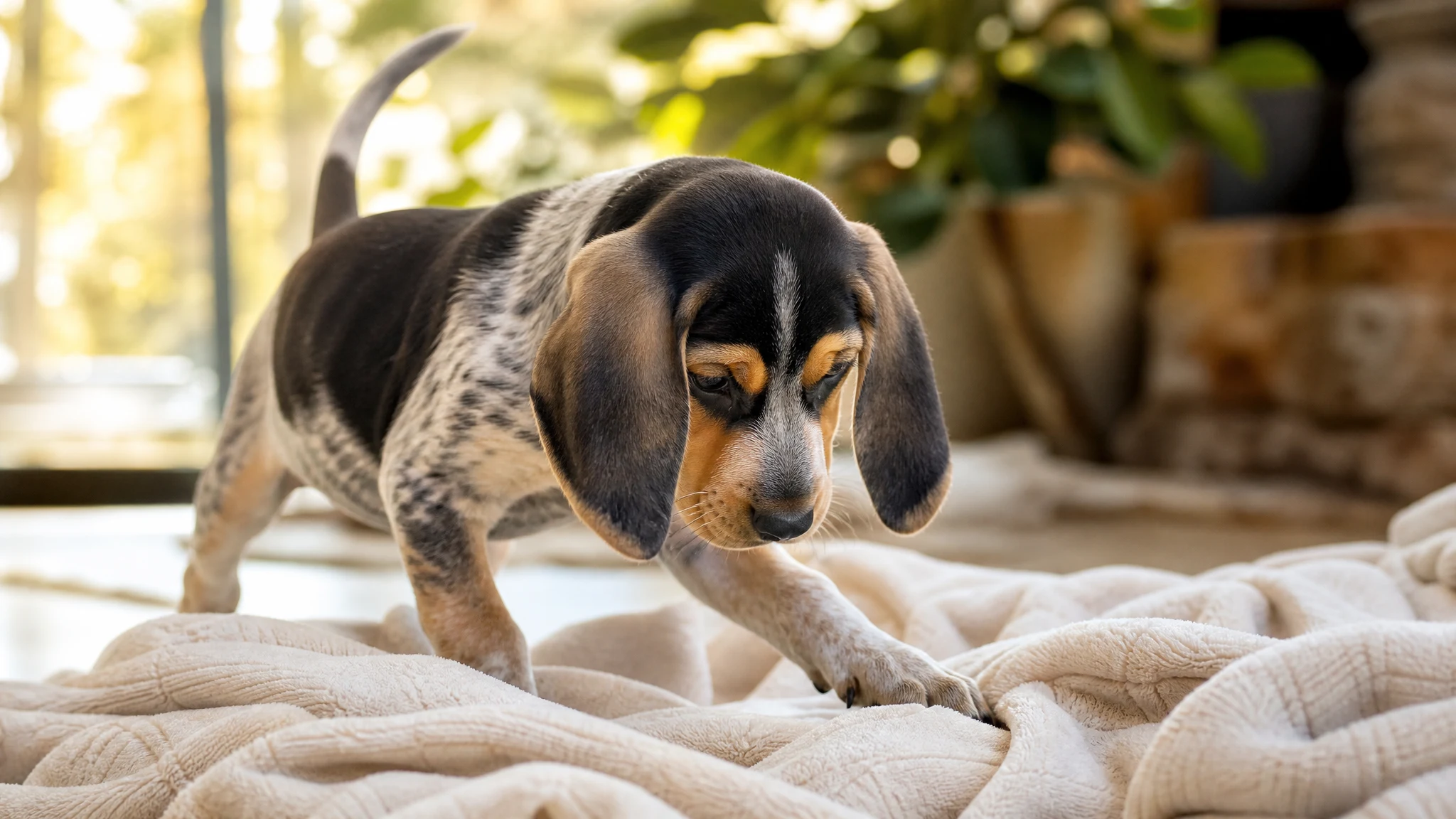
A coonhound puppy arrives with big ears, a bigger nose and a plan of his own. Anyone who has followed a scent trail across a yard with a hound on the end of the leash knows the feeling. This guide lays out a coonhound puppy training schedule from the first weeks at home through the second birthday, with the reasoning behind each stage.
One note on scope. The AKC recognises six separate coonhound breeds: American English, Black and Tan, Bluetick, Plott, Redbone and Treeing Walker. The breed facts in this guide come from sources on the Black and Tan Coonhound, the first AKC coonhound. If you own one of the other five, check with that breed's club and your breeder for details, because individual breeds and individual dogs vary.
The ages below are a planning frame, not a rulebook. Every puppy moves at his own pace, and hounds are known for taking their time on some things.
Contents
- Key takeaways
- What to know about the breed before you start
- Weeks 8 to 12: settling in and the socialization window
- Months 3 to 5: house training, bite inhibition and manners
- Months 6 to 12: adolescence
- Months 12 to 24: maturity
- Coonhound puppy training tips that apply at every age
- Sources
Key takeaways
- Start early and use positive reinforcement. Embrace Pet Insurance notes that food rewards work well for the Black and Tan Coonhound.
- Hill's Pet Australia says the breed can be more challenging to train than other breeds and needs patient, consistent training.
- Orvis lists easy distraction, scent chasing and howling among the known challenges, and advises keeping the dog on leash.
- Vetstreet recommends a securely fenced yard plus at least a half hour walk once or twice daily for an adult. Hill's says more than 40 minutes a day.
- How much exercise a growing puppy should get, and when joints are ready for harder work, is a question for your veterinarian and breeder. We do not have a reliable breed-specific figure to give you.
- Use only reward-based methods, in line with the American Veterinary Society of Animal Behavior (AVSAB).
What to know about the breed before you start
Training goes better when you understand what the dog was built to do. According to Hill's Pet Australia, the Black and Tan Coonhound was used for raccoon hunting as a trail and tree hound, and also on opossum and larger game. Vetstreet says the breed was developed in the southern United States in the late 18th century from Foxhounds and probably the Bloodhound.
That history explains a lot of puppy behavior. A nose-down, wandering, hard-to-recall puppy is doing what his ancestors were selected to do. It is not spite.
Temperament in plain terms
Hill's describes the breed as responsive, intelligent, loyal and passionate about his work. They are generally outgoing and friendly, though some are reserved with strangers. Orvis describes the breed as devoted to family and kind and gentle with people of all ages. Vetstreet says the breed should never be aggressive toward other dogs.
These are breed descriptions, not promises about your puppy. Your job is to build on a good foundation, not assume it.
Size and what it means for training
Vetstreet gives a height of 23 to 27 inches at the shoulder. Weight figures conflict between sources: Vetstreet says 65 to 100 pounds, while Hill's Pet Australia gives 60 to 75 pounds for males and 55 to 70 pounds for females. Either way, this is a large hound. A pup who jumps, pulls or mouths at 15 pounds will be doing it at several times that weight, so habits you tolerate now become problems later.
Energy and exercise
Hill's lists the energy attribute as laid back, yet also states that vigorous daily exercise is a must. Both can be true: many hounds relax well indoors once their needs are met. Vetstreet suggests at least a half hour walk once or twice daily, on leash, along with a securely fenced yard. Hill's puts it at more than 40 minutes a day.
Those figures are for adult dogs. We have no breed-specific puppy exercise numbers from these sources. Ask your veterinarian how much and what kind of activity suits your puppy at each age, especially while his bones and joints are still developing.
Weeks 8 to 12: settling in and the socialization window
The first weeks are about safety, routine and gentle exposure to the world. Do not expect polished obedience. You are building trust and good habits.
Set up the routine
Pick feeding times, potty times, nap times and play times, and keep them steady. Puppies learn faster when the day is predictable. Use a crate or a puppy-safe room for rest, introduced with treats and a comfortable bed, never as punishment.
Begin socialization carefully
Early weeks are when many puppies are most open to new experiences, which is why trainers put so much weight on this period. Aim for calm, positive encounters with different people, surfaces, sounds and gentle, healthy dogs. Pair each new thing with a treat.
Ask your veterinarian what is safe before your puppy has finished his vaccinations. Many owners carry the pup, visit friends' clean yards or arrange meetings with vaccinated dogs rather than visiting busy dog areas. Your vet knows the disease risks where you live.
Because some Black and Tan Coonhounds are reserved with strangers, per Hill's, let your puppy approach new people at his own pace. Ask visitors to offer a treat rather than loom over him.
Teach the first skills
- Name response: say his name, reward when he looks at you.
- Sit and down: lure with a treat, mark the moment he does it, reward.
- Handling: touch paws, ears and mouth briefly, then reward. Floppy ears get ear infections, according to Embrace Pet Insurance, so a puppy who accepts ear handling makes vet care easier.
- Leash introduction: let him wear a light collar or harness and drag a short leash indoors while you supervise.
Months 3 to 5: house training, bite inhibition and manners
This is the busiest teaching stage. Keep sessions short, a few minutes at a time, and end while the puppy is still keen.
House training
House training is about management and repetition. Take your puppy out:
- First thing in the morning and last thing at night
- After meals, naps and play
- Any time he starts circling or sniffing with purpose
Go to the same spot, wait quietly and reward right after he finishes, while he is still outside. Hounds love to sniff, so the outing can turn into a scent tour. Keep the leash on, give him a minute or two to do his business, and save the exploring for after the reward.
If an accident happens, clean it with an enzymatic cleaner and move on. Never scold or punish. It teaches a puppy to hide, not to wait.
We do not have a reliable breed-specific age for full house training. If your puppy is still having frequent accidents or suddenly regresses, talk to your veterinarian, since medical issues can play a part.
Bite inhibition
Puppies explore with their mouths. The goal is not to stop mouthing overnight but to teach softness, then replace it with appropriate chewing.
- Offer a chew toy when your puppy mouths your hands.
- If teeth land on skin, calmly stop the game, stand up and turn away for a few seconds.
- Resume play when he is calm, and praise gentle behavior.
- Keep a stash of chews in every room, rotated to stay interesting.
Do not hold his mouth shut, flick his nose or use any physical correction. These methods can frighten a puppy and are not supported by AVSAB guidance. Tired puppies bite more, so a nap often solves a mouthy evening.
Basic manners
Add these skills to the first set:
- Come when called: practice indoors, then in the yard on a long line. Make it the best thing that happens all day, with high-value treats.
- Loose-leash walking: reward him for staying beside you and stop moving when the leash goes tight.
- Settle on a mat: reward calm behavior, which pays off later in the house.
- Leave it: an important skill for a scent-driven puppy who will want to eat everything he finds.
Hill's says the breed needs patient, consistent training, and Orvis notes these dogs can be easily distracted and not always willing to do as asked. Train in quiet places first, then slowly add distractions.
Learning to be alone
Practice short separations from the start. Give your puppy a chew, step out for a minute, and return before he gets upset. Build the time slowly. Orvis lists howling as a challenge for the breed, and a puppy who has learned to be comfortable alone is less likely to rehearse it.
Months 6 to 12: adolescence
Many owners hit a wall here. The puppy who learned everything so nicely now acts as if he has never heard of sit. This is a common stage for dogs of all breeds and usually does not mean training has failed.
What to expect
- Selective hearing, especially outdoors
- More interest in scents and more pulling toward them
- Testing of rules that used to be settled
- Possible new wariness of unfamiliar things
Orvis says the breed chases scents, so keep your hound on leash. A puppy who bolts after a trail in this stage may ignore your recall entirely. Use a long line in unfenced areas, and do not let him off leash in open spaces until your veterinarian and trainer agree he is reliable. Vetstreet also stresses a securely fenced yard.
How to keep making progress
Go back to basics rather than getting frustrated. Raise your rate of reward, shorten sessions and practice in easier settings before moving to hard ones. Food rewards work well for the breed, per Embrace Pet Insurance, so keep treats on you.
Consider a reward-based group class. Look for a trainer who clearly uses positive reinforcement and avoids shock, prong or choke collars and dominance methods. Ask to watch a class before you sign up.
Give the nose a job
Embrace Pet Insurance suggests tracking and search and rescue as activities for the breed, in addition to raccoon hunting. You do not need to enter a sport to use the idea. Scatter treats in grass, hide toys, or lay a simple scent trail and let him work it out. A dog who has used his nose is often calmer afterward. For organized scent work or tracking, check with the relevant club or organization about what is available and what the requirements are.
Joint care and growth
Hip dysplasia is among the common health issues listed by Embrace Pet Insurance for the breed. Vetstreet lists hip evaluation (OFA or PennHIP), eye certification through the Canine Eye Registry Foundation and an OFA cardiac evaluation as health screens. Ask your breeder which of these the parents have had.
We do not have a source that gives a breed-specific age for when a coonhound's growth finishes or when hard exercise becomes appropriate. Ask your veterinarian about:
- How much running, jumping and stair climbing is suitable now
- How to keep your puppy lean, since extra weight stresses joints
- What to watch for, such as limping or reluctance to move
Do not diagnose problems yourself. Any limp, stiffness or change in behavior deserves a veterinary visit.
Months 12 to 24: maturity
By the first birthday your hound may look grown, but we have no breed-specific source on when a Black and Tan Coonhound reaches mental maturity. Ask your breeder or the American Black and Tan Coonhound Club, named by Wikipedia as the parent club. We could not confirm a web address for the club, so ask your breeder for contact details.
Plan for a long finish. Treat the second year as a time to keep practicing, not a time to stop training.
Strengthening what you built
- Recall: keep using a long line and keep paying well. Even a polished recall can fall apart in front of a fresh trail.
- Leash manners: a large hound who pulls is hard to walk. Keep rewarding position beside you.
- Greeting behavior: teach all four paws on the floor before people get attention.
- Calm in the house: reward quiet lying down so it becomes the default.
Exercise as an adult
Once your veterinarian says he is ready, work toward the adult exercise levels the sources describe: at least a half hour walk once or twice daily on leash per Vetstreet, or more than 40 minutes a day per Hill's. Add sniffing time. A slow, sniff-heavy walk can be worth more to a hound than a fast one.
Ongoing health care
Embrace Pet Insurance lists autoimmune thyroiditis, ectropion, hemophilia B in some dogs and ear infections from floppy ears among issues for the breed. Vetstreet also mentions coonhound paralysis. Talk with your veterinarian about what these mean for your dog and which routine checks make sense. Orvis gives a life expectancy of 10 to 12 years, so the habits you set at two will be with you a long time.
Coonhound puppy training tips that apply at every age
Use rewards the dog actually wants
Embrace Pet Insurance says to begin early with positive reinforcement and that food rewards work well. Use small, soft treats you can deliver fast. Take them out of the daily food allowance if weight is a concern.
Be consistent as a household
Everyone should use the same cue words and the same rules. If one person allows jumping and another does not, a clever hound will learn which person to work on.
Keep sessions short and frequent
Several three to five minute sessions beat one long one. Stop before your puppy gets bored or you get annoyed.
Manage the environment
Use a fenced yard, a leash and baby gates so your puppy cannot practice the wrong behavior. Management is a tool, not a failure.
Plan for howling
Orvis lists howling among the breed's known challenges. We do not have a sourced barking rating for the breed. Reward quiet moments, meet exercise and company needs, and talk to your neighbors early. If vocalizing becomes a serious issue, ask your veterinarian to rule out medical causes and consult a reward-based trainer.
Avoid harsh methods
Shock, prong and choke collars, alpha rolls, scruffing and dominance methods are out. AVSAB supports reward-based training because punishment can increase fear and stress. They also damage the trust that makes a loyal hound a pleasure to live with.
A simple timeline at a glance
| Stage | Main focus | Key reminder |
|---|---|---|
| 8 to 12 weeks | Routine, gentle socialization, name, sit, handling | Ask your vet what is safe before vaccinations are complete |
| 3 to 5 months | House training, bite inhibition, recall, leave it | Keep the leash on outdoors |
| 6 to 12 months | Adolescence, long-line work, nose games | Go back to basics when he "forgets" |
| 12 to 24 months | Proofing, adult exercise, calm habits | Ask your breeder and vet about maturity and joints |